Learning to Discern
Truth can be difficult to recognize, but it is not divided. Across countless denominations and theological systems, many conflicting explanations are offered—all claiming to be correct. Yet, what is true remains singular.
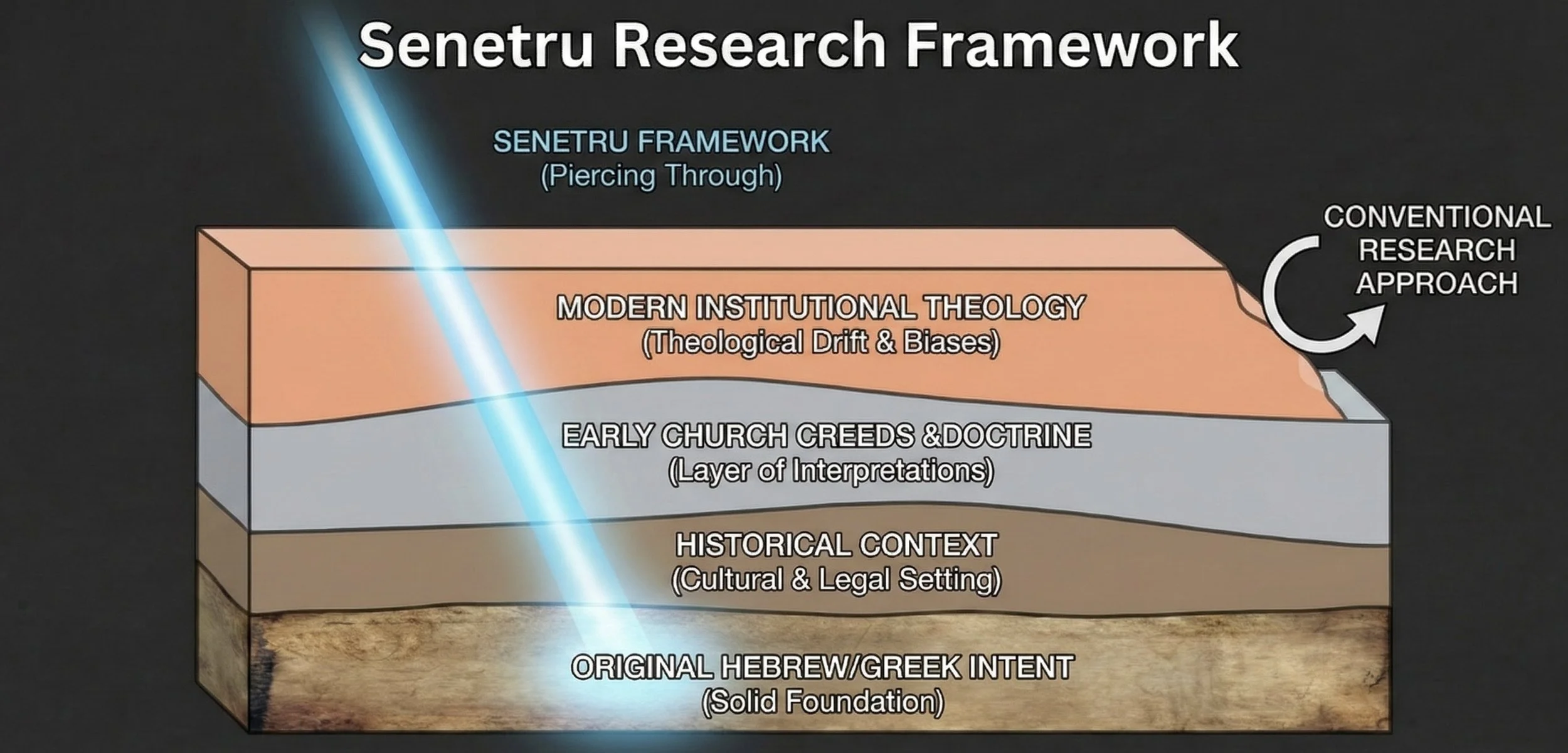
Over centuries, layers of tradition and inherited doctrine have pre-packaged how Scripture is understood. These layers often act as a filter, preventing us from seeing the original intent of the writers. At Senetru, our data is not gathered through the lens of institutional theology. Instead, we adhere to a strict methodology of returning to the most original Hebrew and Greek manuscripts, stripping away the inherited assumptions and imported doctrines of the institutional church to see what the text actually supports.
Our Research Methodology
We do not rely on concordances, commentaries, or doctrinal summaries. Our process is rooted in:
Original Language Priority: We engage directly with the earliest available manuscripts.
Term Integrity: When the Greek uses Logos or Agape, we retain those specific terms to avoid the baggage of modern English "equivalents."
Philological Grounding: We prioritize the study of language in its original historical context—we look at how words were actually used by the authors at the time they were written, rather than how those words have been redefined by religious institutions over the last 1,700 years.
Theological Neutrality: We refuse to assert Nicene Trinitarian theology or any other post-scriptural framework onto the text.
Bypassing Tradition: We identify exactly where human assumptions have replaced scriptural authority.
The Purpose of These Resources
The resources on this page are not a replacement for study, but a roadmap for it. They are designed to bring your attention back to the language, context, and original intent of the text, helping you identify exactly where human assumptions have replaced scriptural authority.
Our goal is to provide a clear path for those seeking to:
Access Senetru’s Research: Streamline your engagement with our books and publications to see how we have arrived at our conclusions through original manuscript analysis.
Navigate Modern Tools: Gain guidance on how to use AI and digital resources effectively without falling into the trap of institutional bias pre-packaged theological answers.
Apply Scriptural Logic: Reclaim the use of sound reason and philological context to discern the true meaning and intent of the Scriptures, moving past Sunday school traditions to see what the text actually supports.
YOU Must Seek Yahweh
These resources are not the source of truth. Yahweh alone is that source. The information provided here serves as a study aid—a digital shovel to help you dig through the rust of tradition. Our research is intended to support an honest examination of Scripture as you grow in clarity through total dependence on the guidance of the Most High.
Without the Spirit, there is no discernment. We provide the data and the framework, but the understanding must be sought from the Father.
“Trust in Yahweh with all your heart, and lean not on your own understanding; in all your ways acknowledge Him, and He shall direct your paths.” —Proverbs 3:5–6

Senetru Answers
Refined by fire. Set apart by truth.
Ask Senetru
Explore our published works — select a question below or ask your own.
Using AI as a Scripture Study Tool

Seek the Source First
There is no path to knowledge of the Father other than to be with Him. Understanding does not come through the mastery of information or the clever use of technology; it comes through total surrender to the Spirit. Before engaging with any book (including Scripture), study aid, or AI, you must first seek the Father. Truth is spiritually discerned, and without His guidance, you are merely processing data without life.
The Consensus Warning
AI is a consensus engine, not a truth engine. It does not know what is true; it only knows what has been written and repeated the most.
History shows the consensus is often dead wrong. As an example, for a long time, even the most famous doctors believed that they didn't need to wash their hands before helping a patient. Because "everyone" believed it, they kept doing it, and people kept getting sick. One doctor suggested they wash their hands to stop the spread of germs, and the majority laughed at him and ignored the truth for years. The other doctors didn't believe him. They were offended that he suggested their hands were dirty. The medical community laughed at him, ignored the proof, and eventually fired him. Thousands of people continued to die for years because the majority refused to change what they already "knew."
If you do not give the AI specific boundaries, it will give you the “unwashed” answers because that is what it finds most often in its database. 1,700 years of lies do not equal truth.
AI as a Tool for Verification
*Podcast Available Below*
The discernment of the Spirit is non-negotiable. You cannot trust what an AI output provides at face value. You must ask Yahweh what is true and use the AI only as a means to confirm and verify the structural or linguistic data He has already set before you.
No Substitutes: Truth is not confirmed by your feelings, the opinions of pastors, or subjective dreams and visions. Yahweh must confirm His Truth.
Direction First: AI is only helpful when Yahweh has already provided direction based on Truth. In that context, it acts as a digital shovel to help you dig through the historical and linguistic rust that has buried the original intent of the Word.
Active Discernment: Use these tools to organize information and examine the mechanics of language, but always bring that data back to the Father for final discernment.
“The natural man does not receive the things of the Spirit of God, for they are foolishness to him; nor can he know them, because they are spiritually discerned.” —1 Corinthians 2:14
Imperatives for Using AI
1. Turn on "Think" Mode
Set the AI to “Reasoning” or “Think” mode. You can usually find this by looking for a "Think" button or a "Reasoning" toggle near the text box where you type.
What it does: Standard AI is like a fast-talking salesperson—it gives you the quickest, most popular answer. Think mode forces the AI to slow down and follow a logical chain of events. It checks its own work against your rules before it speaks.
The Value: If the AI isn't "thinking," it will just spit out the same Sunday School answers everyone else hears. This mode forces it to actually look at the ancient manuscripts you've demanded.
2. Demand the Foundation
Tell the AI to us the Codex Vaticanus and Codex Sinaiticus. These are the oldest nearly complete Greek records. They were written before many church doctrines were even invented.You can use a modern Bible as your starting point, but you must direct the AI to look past the English translation. Modern Bibles were often put together by committees who adjusted the wording to fit pre-existing doctrine. To find the original intent, you have to go to the earliest records.
The Value: This lets you see the text before it was polished or changed to support institutional theology and doctrine.
3. Use Philology (The "Everyday" Meaning)
Tell the AI to use philology. This is just a fancy word for looking at how people actually used words in their daily lives when the Scriptures were written.
The Value: For example, in a modern church, faith is usually just an emotion or a mental belief. But in the original Greek, the word is Pistis. Philology shows that Pistis was a common word for loyalty or allegiance—the kind you owe a King or a Father. It wasn't a feeling; it was a commitment to stay true to a relationship for your entire life.
4. Block All Filters
Explicitly tell the AI to ignore pre-set belief systems including concordances, lexicons, bible commentaries, institutional theology, existing doctrine and websites like BibleHub, Blue Letter Bible and all denomination website. If you don’t, it will just tell you what you already believe or what institutions say you should believe. You want truth to determine your belief, not your belief to determine the truth.
Concordances and Lexicons: These rely on modern religious definitions that were created centuries after the fact. They often change the original meaning of words like Logos and Agape to fit church doctrine instead of their literal manuscript intent.
Bible Commentaries: These are simply the personal opinions of writers trying to make the text align with their specific views. They act as a filter that tells you what to think instead of letting the original text speak for itself.
Institutional Theology: These are man-made systems and doctrines—like Nicene Trinitarianism—that were developed long after the original manuscripts were finished. They force later ideas and philosophies onto the original Hebrew and Greek.
Block Religious Search Tools: Websites like BibleHub or Blue Letter Bible are built to support existing church systems. They prioritize biased, pre-determined data that prevents a clean, objective look at the most original manuscripts.
Questions to Ask
Here are some good questions to ask the AI in your study:
What was the original intent of this passage as it would have been understood by a person on the street at the time it was written?
Were there any notable adjustments or corrections made to this verse in manuscripts written after the fourth century?
What are the most common religious misinterpretations of this verse that are not actually supported by the Greek or Hebrew grammar?
Ask what key words in a passage mean in their original intent. (Ex: What does the word “love” mean here? What does it mean to “believe?”)
USING AI TO STUDY SCRIPTURE
In this episode of the Senetru podcast, we discuss how to use AI as a tool to excavate the text of scripture and bypass 1,700 years of institutional doctrine.
Identifying and Correcting AI Drift
The goal of this process is to uncover original intent and meaning. You are looking for the text exactly as it was written, not an interpretation that is filtered through an existing doctrine or what someone else already thinks it means.
AI models are trained on centuries of church-speak and institutional commentary. Even with precise directives, they often default to majority-held traditions rather than sticking to the original manuscript. You must stay alert to catch when the AI stops analyzing the source and starts repeating its training data.
Signs of Institutional Drift
Watch for these red flags. If you see them, the AI has likely stopped looking at the manuscripts and started preaching.
Theological Labels: The AI uses titles or concepts like the Trinity, God the Son, or Co-Equal. These are later developments and do not appear in the original text.
Emotional Fluff: Instead of explaining the legal or covenantal requirements of a word, it gives a devotional answer focused on how you should feel.
The Scholarly Dodge: It uses phrases such as many scholars believe or traditionally this means. This is a sign it is avoiding the hard, literal root of the Greek or Hebrew.
Prohibited citations: If the AI lists any of the prohibited, unrequested sources then drift has occurred (Ex: concordances, bible commentaries, online sources like biblehub.org, denominations website, etc.).
Circular Definitions: It explains one religious word by using another. For example, it might define faith as belief without ever touching the Greek word Pistis (the root of faith and belief) or its origin in loyalty and allegiance.
Missing Evidence: The AI provides a translation but fails to name the specific manuscript, such as Codex Vaticanus, or a historical example of how the word was used in everyday life.
How to Refocus the AI
When you spot drift, do not let the AI continue. Pull it back to the manuscripts immediately with a firm correction.
The Reset Command: Tell the AI: You are drifting into church doctrine and modern tradition. Stop. Go back to the earliest Greek or Hebrew text for this verse. Give me the governing meaning of the word from the time it was written. Ignore all later theology.
The Fresh Start: If the AI remains stuck in a loop of religious talk, start a new session. Re-enter your core imperatives and ask the question again.

RECOVERING MEANING

Scripture was not written in English. The Old Testament was primarily written in Hebrew and the New Testament in Greek. Today, hundreds of English translations exist, but in an effort to be readable, many have smoothed over critical distinctions.
When multiple, distinct original terms are compressed into a single, familiar English word, meaning shifts without the reader even realizing it. Senetru Answers has done some of the detailed research needed to unearth the language nuances. A few critical examples of the results are below.
The Flattening Effect
1. Love — Alignment vs. Emotion
English uses one word—love—to represent seven different original words in Scripture. These are not just "shades" of a feeling; they describe entirely different orientations of the heart and legal standings.
The Drift: Most people read "love" as an emotional sentiment or a feeling of affection.
The Recovery: The most common New Testament word, Agapē, refers to alignment with Yahweh. It is an orientation that flows from Him and is proven by obedience and structural agreement, not by how a person feels.
2. God / LORD — Authority vs. Identity
Across the Hebrew and Greek Scriptures, there are nine different original words that English translations render simply as “God” or “Lord.”
The Drift: Using these generic titles as names often blurs the distinction between the Source and those in positions of authority.
The Recovery: In the original languages, these terms are also used as titles for rulers, judges, or spiritual beings, where the context determines the level of authority. Yahweh is the only name consistently used for the Most High alone. When we use generic titles, we risk losing the specific identity of the Father.
3. Logos ("Word") — Will & Intent vs. Ink or Person
One of the most deeply embedded institutional assumptions is that "The Word" (Logos) refers exclusively to the Bible as a document, or to Jesus in a flattened, philosophical sense.
The Drift: Reducing Logos to a book or a static document.
The Recovery: In the Greek, there are five different words for "word." Logos is Yahweh’s living will, intent, and self-expression.
It is living and powerful (Hebrews 4:12).
It multiplies (Acts 6:7).
It was embodied in the Son (John 1:14).
The writers of Scripture did not possess a "Bible"; they were bearing witness to the Logos—the living will and intent of God active in the world. A book cannot fulfill what Scripture describes the Logos as doing.
“For the Logos of God is living and powerful, and sharper than any two-edged sword, piercing even to the division of soul and spirit, and of joints and marrow, and is a discerner of the thoughts and intents of the heart. And there is no creature hidden from His sight, but all things are naked and open to the eyes of Him to whom we must give account.” —Hebrews 4:12-13